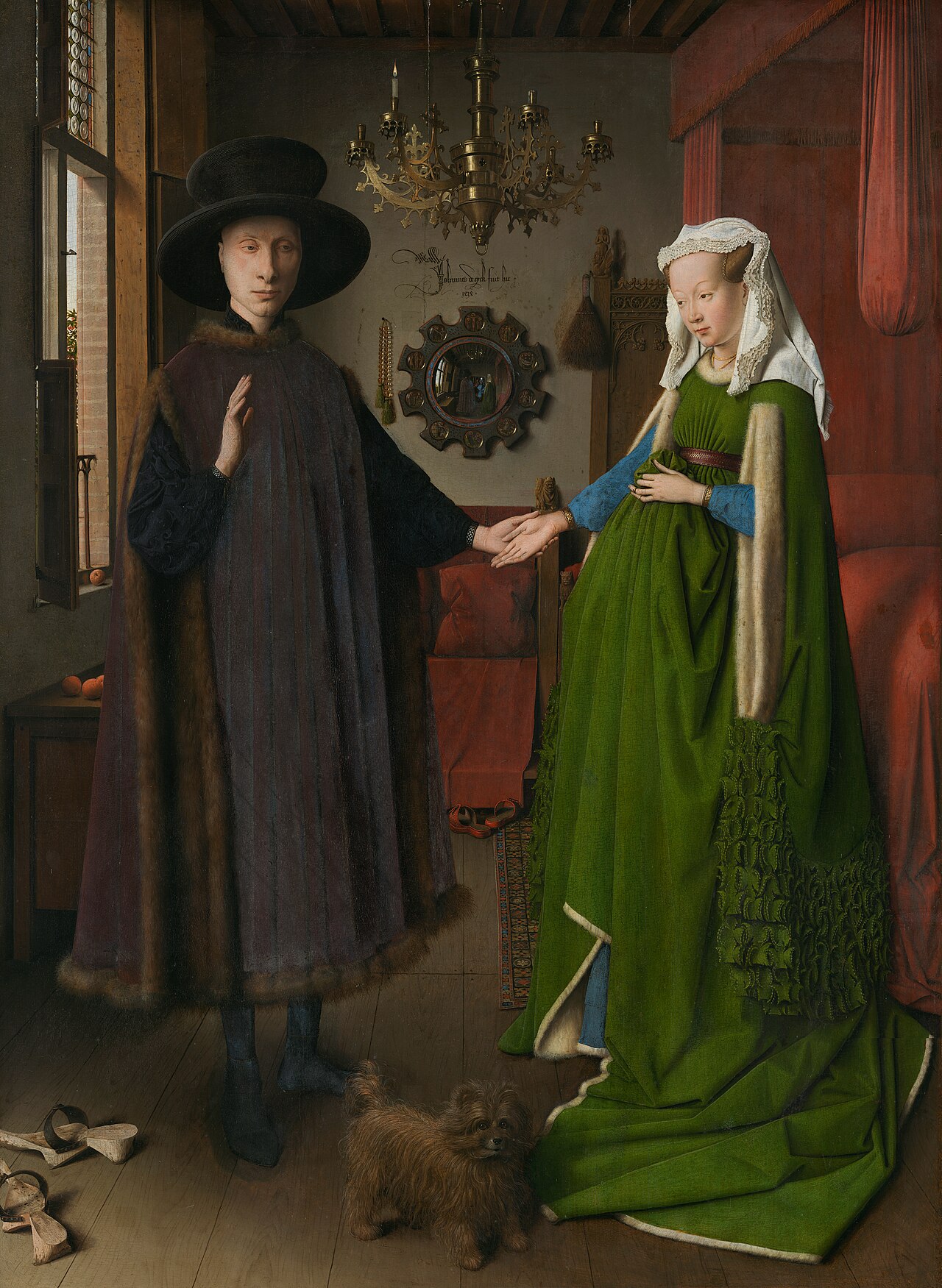


Giovanni di Nicolao Arnolfini, a wealthy Italian merchant in Bruges, stands with a woman — almost certainly his wife.
The scene has long been called a wedding portrait, but that is not certain.
What is certain is that nothing in this painting is accidental.
Look at the convex mirror on the back wall.
Reflected in it are two figures standing in the doorway — one may be Jan van Eyck himself.
Above the mirror, in the elaborate script of a legal document, he has written: Johannes de Eyck fuit hic 1434 — Jan van Eyck was here.
The single candle burning in daylight, the shoes left on the floor, the little dog: all of it carries meaning, though scholars have spent centuries disagreeing about exactly what.
Fun fact: van Eyck did not invent oil paint, but he perfected it.
The detail in this picture — the texture of the fur trim, the stubble on Arnolfini's chin, the light falling through the window — was simply not possible before.
It changed what painting could do.