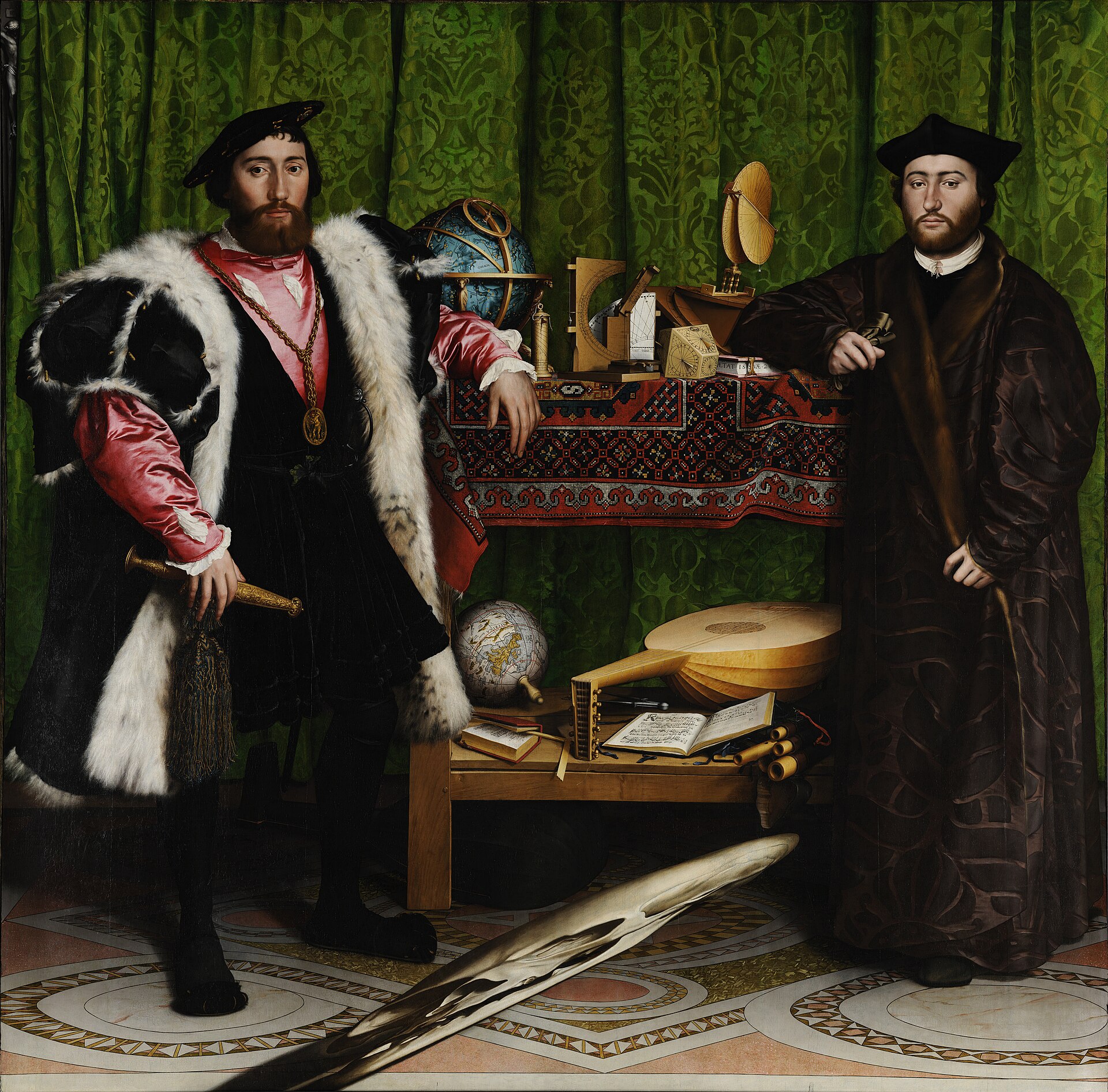


Jean de Dinteville, French ambassador to England, stands on the left.
Georges de Selve, Bishop of Lavaur and his close friend, stands on the right.
Between them: two shelves stacked with objects — celestial globes, a lute, a case of flutes, a book of arithmetic, an astronomical instrument.
Everything a Renaissance man might need to master the world.
Then look at the floor.
Stretched diagonally across it is a blurred, elongated shape.
Step to the far right of the painting and look back: it resolves into a human skull.
A memento mori — a reminder of death — hidden inside a portrait of worldly success.
One of the lute strings is broken.
The Reformation was tearing Europe apart in 1533, and Holbein embedded the discord quietly in the canvas.
Fun fact: the skull is painted using anamorphosis — a mathematical distortion technique that requires a precise viewing angle to resolve.
In a Tudor great hall, it would have been a remarkable effect: invisible from the front, suddenly revealed to anyone who happened to stand at exactly the right spot by the door.